Posted on

New: AI Label Designer – Turn Your Ideas into Pro Designs in Seconds

Designing labels with a simple Ai prompt.

We’re excited to launch our brand-new AI Online Designer – the fastest way to create stunning, print-ready labels and stickers.

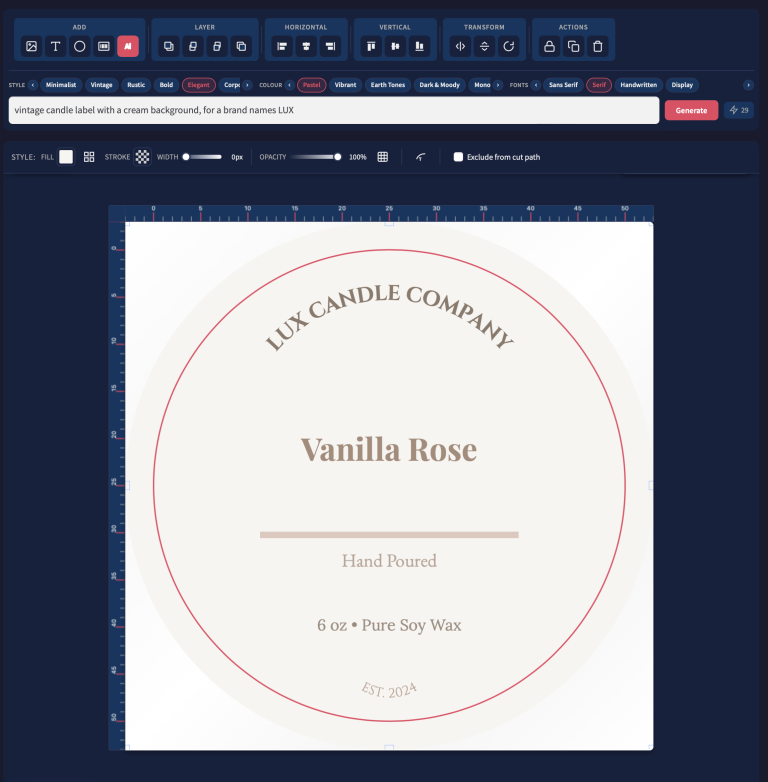
Designing labels and stickers with Ai. Simply enter a prompt and we'll create an editable label for you.

Here’s how it works: Simply type a prompt like “an elegant candle label for a brand named LUX” and our AI instantly generates a complete, professional design. You can then edit everything directly in our powerful online editor – move elements, change fonts, adjust colors, add curved text, insert barcodes, and more.

Key features you’ll love:

  • Curved & arched text
  • Multiple barcode types (EAN, UPC, QR, etc.)
  • Full editability – tweak any part of the design
  • Print-ready output in seconds
  • Works perfectly with all our premium materials

Try these prompt examples:

  • “Minimalist white wine label for a Chardonnay, elegant gold foil accents”
  • “Bold modern sticker for organic coffee, dark green and black, recyclable symbol”
  • “Playful kids toy label – bright colors, cartoon robot, 50mm round”
  • “Luxury skincare jar label – soft pastel pink, serif typography, rose gold effect”

10 Free Credits on Signup Every new account starts with 10 free credits so you can test the AI Designer risk-free. Each generated design uses just one credit.

Prefer to design your own way? No problem. You can still upload your own artwork, logos, or start completely from scratch in the same editor. The AI is here to help when you want speed and inspiration – not replace your creativity.

Whether you need one label or thousands, our AI Designer saves you time, money, and design fees while delivering professional results every time.

Ready to create your first label in under 60 seconds?

Plant Labels & Nursery Stickers: Care Instructions, Pot Labels & Outdoor Durability

Plant Labels Need Outdoor Durability

Plant labels face some of the harshest conditions — direct sunlight, rain, soil moisture, watering, temperature extremes, and physical handling. Paper labels fail within days outdoors. Professional plant labels require UV-resistant, waterproof materials.

Types of Plant Labels

  • Pot stickers: Applied directly to pots and containers. Must resist watering and UV.
  • Care instruction labels: Attached to the plant or pot sleeve with watering, light, and temperature guidance.
  • Plant identification: Species name, variety, mature size, and growing conditions.
  • Pricing labels: For garden centre retail display.

Materials

Vinyl is the only suitable material for outdoor plant labels. It resists UV, rain, and soil moisture. For maximum longevity in direct sunlight, laminated vinyl extends life to 5-7 years — outlasting the plant in many cases.

Common Sizes

  • Small pot (9cm): 40mm x 25mm
  • Medium pot (13-15cm): 55mm x 35mm
  • Large pot (20cm+): 70mm x 45mm
  • Stake labels: 80mm x 20mm
  • Hang tags: 60mm x 35mm

Ordering

StickerNation prints plant and nursery labels on UV-resistant waterproof vinyl. Suitable for outdoor garden centre conditions. No minimum order.

Subscription Box Branding: Stickers, Labels & Branded Packaging on a Budget

The Unboxing Is Your Marketing

Subscription boxes live or die on the unboxing experience. Customers share unboxing moments on social media, turning each delivery into potential marketing content. Branded stickers are the most cost-effective way to elevate a plain mailer box into a branded experience.

Key Sticker Types for Subscription Boxes

  • Box seal sticker: 75-100mm logo sticker on the outer box or mailer bag. First branded touchpoint.
  • Tissue paper seal: 25-38mm circle sealing branded tissue paper inside the box.
  • Thank you/welcome card sticker: Personalised message sticker on an insert card.
  • Product identification: Small labels identifying items within the box.
  • Return address label: Branded return label on the box exterior.

Cost-Effective Strategy

Custom printed boxes cost £2-5+ each. Branded tissue paper costs 50p+ per sheet. A 75mm logo sticker on a plain box costs under 10p — achieving 80% of the brand impact at a fraction of the cost. For subscription businesses shipping hundreds or thousands of boxes monthly, this saving is significant.

Materials

Box stickers need to adhere to corrugated cardboard — a textured surface. Standard adhesive works on smooth cardboard; high tack adhesive is recommended for rough recycled or corrugated surfaces.

Ordering

StickerNation offers subscription box branding stickers with no minimum order. Standard and high tack adhesive options available. Design free online.

Custom Logo Stickers for Business Branding: A Complete Guide

Why Logo Stickers Matter

Custom logo stickers are one of the most cost-effective brand marketing tools available. At just pence per unit, they turn every package, laptop, water bottle, and shopfront into a branded touchpoint. Unlike digital advertising that disappears when the budget stops, a physical sticker continues promoting your brand for years.

Popular Uses

Packaging and Shipping

Branded seals on packaging create a premium unboxing experience. A simple circle logo sticker on tissue paper or a box seal transforms generic packaging into branded presentation. Standard sizes: 25-38mm circles or 50x30mm ovals.

Promotional Giveaways

Stickers are the original viral marketing. A well-designed sticker that people actually want to display — on laptops, water bottles, phone cases — provides ongoing brand exposure at virtually zero cost per impression.

Vehicle and Equipment Branding

Logo stickers on company vehicles, tools, equipment, and fleet vehicles provide professional branding without the cost of full vehicle wraps. Waterproof vinyl with UV protection ensures they last 3-5 years outdoors.

Retail and Events

Point-of-sale stickers, event branding, exhibition giveaways, and retail window stickers all leverage logo stickers for high-impact, low-cost visibility.

Choosing the Right Material

  • Gloss white vinyl: Maximum colour vibrancy and visual impact. Best for bold, colourful logos.
  • Matte white vinyl: Premium, sophisticated feel. Best for luxury, artisan, or minimalist brands.
  • Clear vinyl: No-label look. Logo appears printed directly on the surface.
  • Metallic: Gold or silver for premium brand positioning.

Size Guide for Logo Stickers

  • Packaging seals: 25-38mm circles
  • Laptop/water bottle: 50-80mm
  • Vehicle decals: 150-300mm
  • Window signage: 200mm+
  • Giveaway stickers: 50-70mm die-cut to logo shape

Die-Cut vs Standard Shapes

Die-cut stickers follow the exact outline of your logo, creating a custom shape. This looks more professional and premium than a simple rectangle or circle. However, contour-cut stickers use slightly more material and may carry a small premium for complex shapes.

For simple logos, a circle or rounded rectangle works well. For distinctive logo shapes, die-cutting is worth the investment — it makes the sticker itself a design element.

Design Tips

  • Simplify for small sizes: Fine details disappear below 30mm. Use a simplified version of your logo for small stickers.
  • Add bleed: Extend colours 3mm beyond the cut line to prevent white edges.
  • Consider the background: Will the sticker go on white surfaces? Dark surfaces? Both? A white border or outline ensures readability on any background.
  • Make it worth displaying: Promotional stickers should be designed as something people want to show off — not just an advert.

Ordering Logo Stickers

StickerNation offers custom logo stickers in any size, shape, and material. Die-cut to your exact logo shape with no setup fees and low minimum quantities from just 25 stickers. Design online for free or upload your artwork.

Food Supplement Labels UK: Regulations, Health Claims & Compliance

Supplement Labelling Is Heavily Regulated

Food supplements in the UK are regulated under The Food Supplements (England) Regulations 2003 and general food labelling rules. Additionally, any health or nutritional claims made on labels are strictly controlled by EU Regulation 1924/2006 (retained in UK law). Making unauthorised health claims can result in enforcement action and product removal.

Mandatory Information

  • Product name including food supplement
  • List of nutrients/ingredients with quantities per daily dose
  • Recommended daily dose
  • Warning not to exceed stated dose
  • Statement that supplements should not be used as a substitute for a varied diet
  • Keep out of reach of children statement
  • Net quantity (number of capsules/tablets or weight/volume)
  • Best before date
  • Batch number
  • Business name and address
  • Storage conditions
  • Allergen declarations where applicable

Health Claims

You can ONLY make health claims that appear on the EU Register of permitted claims. For example, Vitamin C contributes to normal immune system function is a permitted claim. But Boosts your immune system is not permitted as it is not on the register. Medicinal claims (treats, cures, prevents disease) are never permitted on food supplement labels.

Materials

Supplement labels need durability for retail shelf life (often 12-24 months). Vinyl labels resist moisture and handling over long periods. For glass bottles, clear vinyl gives a pharmaceutical-quality appearance.

Common Sizes

  • Capsule bottle (60 caps): 70mm x 40mm front + 70mm x 40mm back
  • Tablet bottle (90 tabs): 80mm x 50mm wrap
  • Powder tub (250g): 100mm x 65mm
  • Sachet: 55mm x 35mm

Ordering

StickerNation prints supplement labels on waterproof vinyl at up to 1440 DPI for sharp regulatory text. No minimum order. Design free online.

Essential Oil Labels: CLP Requirements, Small Bottle Sizing & Material Guide

Essential Oil Labelling Is Complex

Essential oils are concentrated botanical extracts classified as hazardous chemical substances under UK CLP Regulation. Many essential oils are classified as skin irritants, sensitisers, flammable, or hazardous to the aquatic environment. This means every essential oil product you sell must carry CLP hazard labelling — in addition to any cosmetic regulations if the oil is marketed for use on skin.

CLP Classification

Common essential oil CLP classifications include:

  • Skin sensitiser (H317): Almost all essential oils — lavender, tea tree, eucalyptus, citrus oils
  • Skin irritant (H315): Many oils at higher concentrations
  • Flammable liquid (H226): Oils with low flash points
  • Aquatic toxicity (H400/H410/H411): Many terpene-rich oils
  • Aspiration hazard (H304): Some oils if swallowed

Your CLP label must include the appropriate GHS pictograms, signal word, H-phrases, and P-phrases for your specific oil or blend.

Fitting Labels on Small Bottles

Essential oils typically come in 5ml, 10ml, 15ml, and 30ml bottles — some of the smallest containers in consumer products. Fitting all required information on these tiny surfaces is a major challenge.

Standard Dropper Bottle Label Sizes

  • 5ml bottle: 30mm x 15mm (extremely limited space)
  • 10ml bottle: 38mm x 20mm to 40mm x 22mm
  • 15ml bottle: 42mm x 22mm to 45mm x 25mm
  • 30ml bottle: 50mm x 25mm to 55mm x 30mm
  • 100ml bottle: 70mm x 35mm to 80mm x 40mm

Solutions for Small Containers

CLP regulations allow reduced label requirements for containers under 125ml where space is insufficient for all required text:

  • H-phrases and P-phrases may be omitted from the label if included on the outer packaging
  • A fold-out label or peel-back label can provide additional space
  • A QR code linking to full safety information can supplement the physical label
  • Minimum pictogram size may be reduced to match available space (but must remain clearly visible)

Dual Classification

If you sell essential oils for aromatherapy use ON the skin, the product is also classified as a cosmetic and requires cosmetic labelling (INCI ingredients, CPSR, Responsible Person) IN ADDITION to CLP hazard labelling. If sold purely for burner/diffuser use, only CLP applies.

Material Requirements

Essential oil labels face unique challenges:

  • Oil resistance: Spilled essential oil can dissolve some adhesives and inks. Vinyl with UV-cured inks is resistant.
  • Small text legibility: Regulatory text on 10ml bottles must be printed at very small sizes. High-resolution printing (300+ DPI) is essential.
  • Amber/dark bottles: Most essential oils come in dark glass. White or light labels provide necessary contrast for legibility.

Ordering Essential Oil Labels

StickerNation prints essential oil labels at up to 1440 DPI on waterproof vinyl — ensuring even the smallest regulatory text is sharp and legible. Available in any size from 30mm upward. Design free online or upload your artwork.

Custom Cosmetic Labels: Materials, Regulations & Design Guide

Why Cosmetic Labelling Is Unique

Cosmetic labels must withstand water, oils, lotions, and frequent handling while maintaining a premium appearance and complying with strict UK and EU regulations.

Best Materials

Matte white vinyl is the dominant choice — fingerprint-resistant, waterproof, oil-resistant, and gives the premium look consumers expect. Clear vinyl is essential for products where contents colour is a selling point. Metallic finishes add luxury positioning.

UK and EU Requirements

The EU Cosmetics Regulation (EC 1223/2009) requires: product name, INCI ingredients list, net weight/volume, batch number, PAO or best before date, Responsible Person name and address, country of origin, and warnings. Minimum text x-height is 1.2mm.

Design Best Practices

Keep hierarchy clear — brand and product name prominent, regulatory text legible but secondary. Use colour coding across product ranges. Leave space for batch codes. Test labels on your actual product containers before bulk ordering.

Ordering

StickerNation prints custom cosmetic stickers and labels on matte, gloss, clear, and metallic vinyl — all waterproof and oil-resistant. No minimum order. Design free online.

Asset Tags & Serial Number Labels: Tracking, Durability & Barcode Solutions

Why Asset Tags Matter

Asset tags identify, track, and manage physical assets — equipment, tools, IT hardware, furniture, vehicles, and machinery. They enable inventory management, depreciation tracking, maintenance scheduling, theft deterrence, and insurance compliance. For any business with significant physical assets, a consistent tagging system is essential.

Information on Asset Tags

  • Asset number: Unique sequential identifier
  • Organisation name/logo: Identifies ownership
  • Barcode or QR code: Enables scanning for digital inventory systems
  • Department/location: Optional — aids physical tracking
  • Date acquired: Optional — supports depreciation records
  • PROPERTY OF statement: Deters theft

Barcode Integration

Modern asset management systems use barcode or QR code scanning to log assets digitally. Code 128 barcodes are the standard for asset tracking — they encode alphanumeric data compactly. QR codes are increasingly used as they can store more data and are scannable by any smartphone.

Tamper-Evident Options

For high-value assets or security-critical equipment, tamper-evident labels break apart or leave a VOID pattern on the surface when removal is attempted. This deters theft and provides evidence of tampering.

Materials

Asset tags must survive years of use in various environments:

  • Indoor office equipment: Standard vinyl — 5+ years
  • Warehouse/industrial: Heavy-duty vinyl or polyester — chemical and abrasion resistant
  • Outdoor equipment: UV-resistant vinyl or polyester — weather resistant
  • IT equipment: Small format vinyl — fits laptops, monitors, servers

Common Sizes

  • Small (IT equipment): 50mm x 20mm
  • Standard (general assets): 60mm x 25mm or 75mm x 30mm
  • Large (machinery): 100mm x 40mm

Sequential Numbering

Asset tags typically require sequential numbering — each tag has a unique number in a continuous series. Digital printing supports variable data, meaning each label in a batch can have a different number, barcode, and QR code automatically generated from a sequence.

Ordering

StickerNation prints asset tags on durable vinyl and polyester with permanent adhesive. Our online designer includes barcode and QR code generators for asset tracking integration. Sequential numbering available. No minimum order.

Eco-Friendly Stickers: Sustainable Materials & Recyclable Options

The Demand for Sustainable Labelling

Consumers increasingly expect brands to consider the environmental impact of their packaging, including labels and stickers. A 2023 survey found that 73% of UK consumers consider sustainability when choosing between similar products. For brands targeting eco-conscious markets, the label itself sends a message about your values.

Current Sustainable Options

FSC-Certified Paper Labels

Paper labels from FSC (Forest Stewardship Council) certified sources guarantee the paper comes from responsibly managed forests. Paper labels are biodegradable, recyclable (when removed from the product), and have a natural, tactile feel that aligns with eco-friendly branding. However, paper labels are not waterproof and are unsuitable for products exposed to moisture.

Recycled Content Vinyl

Some vinyl manufacturers now offer films containing recycled PVC content. While not biodegradable, these reduce virgin plastic consumption. The recycled content does not affect print quality, durability, or adhesive performance.

Polypropylene (PP) Labels

PP is one of the most widely recycled plastics. PP labels are waterproof, tear-resistant, and can be recycled together with PP product containers — meaning the consumer does not need to remove the label before recycling the container.

Biodegradable Adhesives

Standard permanent acrylic adhesives are not biodegradable. Some manufacturers now offer labels with wash-off adhesives or adhesives that break down in industrial composting conditions. These are suitable for products with a short shelf life where long-term adhesion is not required.

The Honest Reality

Full transparency is important: most custom vinyl stickers are made from PVC, which is not biodegradable or easily recyclable as a label. The print industry is actively developing more sustainable alternatives, but currently no material matches vinyl for the combination of waterproofing, durability, print quality, and cost that most applications require.

The most impactful sustainability choice for most brands is not the label material — it is reducing overall packaging waste, using right-sized labels (less material), and ensuring the product container itself is recyclable.

What You Can Do Now

  • Right-size your labels: Use the smallest label that serves your purpose. A 38mm seal uses less material than a 50mm one.
  • Avoid overlabelling: One well-designed label is better than three separate stickers on the same product.
  • Choose PP for recyclable containers: If your container is PP, a PP label allows single-stream recycling.
  • Use paper where possible: For indoor, dry-environment applications, FSC paper labels are the most sustainable option.
  • Communicate your values: A small recycling symbol or sustainability statement on your label shows customers you care.

Future Developments

The label industry is investing heavily in sustainable innovation. Technologies in development include PHA-based biodegradable films, plant-based adhesives, and water-based UV-curable inks. We expect meaningful commercial options to emerge over the next 2-3 years, and StickerNation will adopt them as they become viable.

Safety Warning Labels & Stickers: Compliance, Durability & Industry Standards

Safety Labels Save Lives

Safety warning labels communicate hazards, mandatory actions, and prohibitions at the point of risk. They are required across virtually every industry — construction, manufacturing, electrical, gas, food processing, and facilities management. A missing or illegible safety label can result in injury, regulatory fines, and legal liability.

Label Categories (ISO 7010)

  • Prohibition (red circle with line): Actions that must NOT be taken — No smoking, Do not touch
  • Warning (yellow triangle): Hazards present — High voltage, Hot surface, Slippery floor
  • Mandatory (blue circle): Actions that MUST be taken — Wear PPE, Eye protection required
  • Safe condition (green rectangle): Safety information — Fire exit, First aid, Assembly point
  • Fire equipment (red rectangle): Fire extinguisher location, Fire alarm

Material Requirements

Safety labels must remain legible for years in harsh conditions:

  • UV-resistant: Outdoor labels must not fade
  • Chemical-resistant: Must survive cleaning solvents and industrial chemicals
  • Temperature-resistant: From cold storage to hot pipe lagging
  • Abrasion-resistant: Must survive contact and handling
  • Permanent adhesive: Must not peel from metal, plastic, concrete, or painted surfaces

Vinyl is the standard material for safety labels. For extreme environments, polyester (PET) labels offer superior chemical and temperature resistance.

Gas Safety Labels

Gas engineers must apply labels indicating gas safety check completion, landlord gas safety record compliance, and any condemned appliance warnings. These labels must be durable, legible, and include the Gas Safe Register engineer number.

Ordering

StickerNation prints safety warning labels on durable waterproof vinyl with permanent adhesive. Standard ISO 7010 symbols or fully custom designs. No minimum order — order exactly what you need.